Saturday, 8 September 2012

Days 522&523: Vientiane to Hanoi part 1

Overland to Hanoi on the "Bus from Hell"

Antonia and I continued our overland adventure from Bangkok to Hanoi to meet up with Penny.  This part of the trip doesn't have a train.  In it's place through Lao is an overnight bus.  Getting from the train to the bus was a bit of a mess.

The train had arrived about 9hrs late and the visa office was closed at the train station.  A bunch of tuktuk drivers were hawking around and wanting to charge us a lot of money to take us to the Friendship Bridge per person.  I went ballistic and a tuktuk driver stepped up and agreed to take us to the boarder and then the hotel for 400 baht which is about $13.  Doesn't sound bad but this is about what you pay for a tuktuk for the entire day.  Eventually we made it to the hotel after a long dusty smelly ride.

The following day we I booked the bus at a local agency near the hotel.  I paid US$40 per ticket.  (I later learned that each agent has their own price for this same bus and some agents were charging half this price.)  The bus company agreed to send around a shuttle at 5pm.  Meanwhile we set out and walked around downtown Vientiane.

This shows a typical telephone pole in Vientiane.  As you can see, the term "rats nest" certainly applies here as it also does in Bangkok.

This appears to be the central office of Vientiane.  Nobody tried to arrest me taking this photo!

Some of the tuktuks were quite nicely decorstaed:

A typical street.  Vientiane is very much a city.  The streets are almost wide enough for 2 cars and there are sidewalks but they're often blocked.  Cars wiz around honking at people.

There are lots of vendors selling stuff in the streets.  We bought some of these round things.  She charged me the equivalent of $1 for 6 of them.  They were delicious.  I'm not really sure what they were.  They were sweet (but not overly so) and had what tasted like custard and sweet corn on the inside.  They were pipping hot and sizzlling on the round black plate you see in the photo.

At 5pm a tuktuk driver showed up at our hotel to pick us up in a larger version of the above pictured tuktuk.  It was open in the back and we didn't exactly feel safe sitting in the back.


The ride to the bus station took about 40 minutes and was a lot longer than I had imaged.  I was told the station was very close by but this was a different station.  It would turn out that this 40 minute ride was the least of our worries and a prelude to what was to come.

Tuesday, 4 September 2012

Day 521: Bangkok again


Antonia and I have arrived back in Bangkok.  Took a taxi from the airport to the same hotel we stayed in a couple months ago.  Flight from Denpasar went without a hitch.

On the plane, we sat next to this Thai gentleman who runs a prawn processing operation near Bangkok.  He is one of the suppliers to Walmart, Albersons and Saveway in the US.  If you've eaten frozen shrimp in the US from a major food store, it's possible you've eaten some of this man's shrimp his company processed!

I must admit that I have long wanted to meet someone in the shrimp packing industry.  I've heard some bad rumors about how shrimp are produced.  It's so difficult to get good information about where our food actually comes from.  It does worry me.

On the 4 hour flight, this man explained to me how tiger prawns are grown and get to the grocer around the world.  I was pretty impressed at the level of control he described.  I had often imagined the origin of seafood from Asia to be sort of dubious but it's apparently quite controlled.  I won't say things are perfect but it's a lot better than I had imagined.

There were some things he said which were quite interesting like that they do not sit there and pump antibiotics or hormones into the water.  These things cost money which the farmers don't have.  In fact, the opposite is true, they use a lot of natural techniques to keep things clean.  He explained one technique to me where they use a "probiotic" enzyme (I didn't catch which one) which keeps bacteria at bay.  If shrimp are not growing, they harvest them small, there's still a market for them.

He told me he packages an organic line of shrimp which are relatively expensive.  The reason they're expensive is a paperwork issue.  In fact the shrimp are the same as the non-organically certified variety!  He is genuinely surprised that people are willing to pay the extra money for what he considered mostly enrichment for the certifier organizations.  The difference is that the farmers who certify their shrimp farms undergo a costly certification process which they must continue to pay (or loose the certification and have to start all over again) and thus they have to pass this cost on to consumers.  He admitted that some of the testing is not appropriate for this area and probably other tests are missing.  The organic label on food is a little misleading in this way.  The high cost of organic food (at least with shrimp) is not at all associated with lower yields due to organic farming methods!

Are things perfect?  No, I doubt it.  He did say some things which I found a little disturbing.  They feed shirmp a mixture of ground up shrimp shells and soy probably other things they use for protein.  The exact mix varies depending on what feed companies mix up that day.  I think some more info on the shrimp food would be interesting.

He is trying to get his farmers to keep more paper records.  Some do and some don't.  It's a long term learning process.  He is trying to show how keeping records helps the farmer recover from costly mistakes like loosing whole lots of shrimp and not knowing why.

He's very open to people coming in and inspect the process.  He has this idea of bringing in essentially "wwoofers" (though he didn't know that term) onto the farms to see the process in action.  "Wwoofing" is a term used to describe people who go and volunteer or take jobs on farms in exchange for room and board.  (see http://www.wwoof.org/history.asp).

He very kindly invited us to come stay with him.  Maybe we will see him again in the future.

And lastly, a question I love to ask farmers is "do you eat what you sell?" and his answer was emphatically yes.

Monday, 3 September 2012

Day 521: Halong Bay

Halong Bay with tour boat
Looking towards the city
Halong Bay really is a long way to go for a day trip (4 hours there and 4 hours back), and also, it really is beautiful.  We took an afternoon cruise past various bits of photogenic scenery and a fishing village, then landed for a tour of the cave formations inside one of the karsts.  The kayaking part of the trip which I had booked didn't happen for reasons that weren't clear to me.  I should say that I have heard from several tourists that they have tried to book more active tours like cycling and kayaking and the active part never really came off. I also noted that the tour companies package people who wanted active tours with people who didn't and in some cases were not physically able. On both tours I went on, there was definite resistance by some members of the group to active parts of the program and/or people with restricted mobility.  It seemed to me that the companies were not really motivated to deliver physically active options to their clients and this is something to watch out for if you fall into that category.

Cave under a karst hill with artificial light show
Same cave with natural light show
In conclusion - Halong Bay is worth it on a day trip if you're really motivated to see Halong Bay, but if you're having to make choices, I would go for Tam Coq

Friday, 31 August 2012

Day 518: Hoa Lu and Tam Coq

Landscape around Hoa Lu

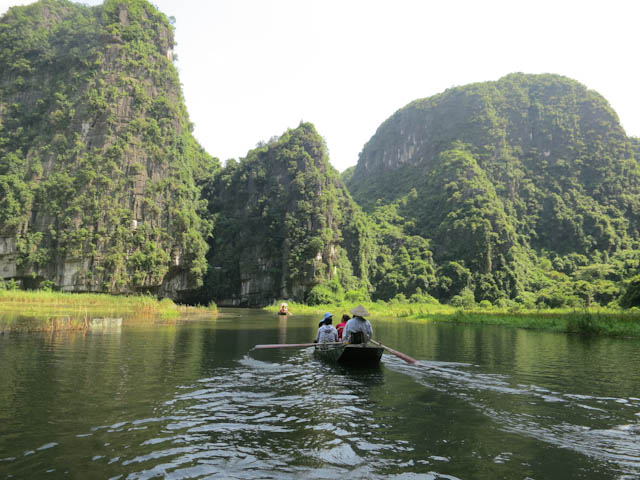
I went on this day trip on a whim, because the museums in Hanoi were going to be shut that day, and it turned out to be one of the nicest trips I've taken.  Not Hoa Lu, specifically, though what's left of this ancient capital of Vietnam was a pleasant diversion.  These days it consists of a couple of attractive temples surrounded by mountains and some open areas where the city was.  What really made the day, coming completely unexpectedly, was the boat ride along the waterways through the landscape of karst hills, and even sometimes under them.  We followed that up with a bike ride, albeit a short one, along a path that would through the rice fields and along the base of the same hills.

Entrance to the tunnel under a karst hill

Waterway through the karst hills
Things to note:
Hoa Lu is 2 hours out from Hanoi, not too bad for a day trip
Keen cyclists shouldn't get their hopes up about the advertised bike ride. It was pretty short.
I doubt the boat rowers get paid much money and it's accepted that they will supplement this with tips, attempts to sell you handicrafts and even what is virtually a scam at the far end of the river trip, where you're encouraged to buy drinks and snacks for your rower even if you don't want any yourself.  I strongly suspect the rowers sell these back to the snack saleswomen later on for a share of the profit.

Sunday, 26 August 2012

Days 507 to 513: Hue

South gate of the Imperial City, where you pay. The citadel is bigger, extends around it and contains houses, cafes, shops, etc.

From the end of the 18th century to the start of the 20th, Hue was Vietnam's capital. I liked it much better than Hoian, even though the food, as several tourists have noted, is far from spectacular. I spent my days wandering around the city, especially the citadel, and the best part of three days inside the imperial city. You have to pay to go in, so it is very nice and peaceful when you get there.  I bought two little books, one which explained all the buildings and one that told stories about the lives of the royal family, the concubines and the legends of the Perfume River running outside. Whenever I got too hot from wandering around, I sat on a bench and read for a bit.  The imperial city really is a city with streets lined with walls.  On the other side of the walls, palaces, temples and theatres are set in gardens with ponds, urns, ornamental plants. There are lots of inscriptions in Chinese and I got a kick out of seeing how many characters I could read (not many).  A lot of imperial city was destroyed during the war, so the best surviving buildings are in the outlying sections.  A lot of renovation and reconstruction is under way, so perhaps Hue will be even more exciting next time I go there.

Building in the Imperial City
Inside one of the palaces, currently under renovation
Looking towards the gatehouse from the temple in honour of the Nguyen emperors

I always wanted to experience Asia's rainy season, and I have been well served. As people who know regularly explain, it doesn't rain all day every day.  What you get is one torrential downpour a day, or maybe every other day.  It's actually rather easy to miss them, but here's some pictures from a time I didn't. I had walked to the train station to buy tickets and decided to walk back on the other side of the river under the walls of the citadel. It was sunny when I made that decision.  As I crossed the fancy new bridge you can see below, I could see blackness rolling up the river towards me.  Luckily, the bridge has been built with shelters.  I waited about half an hour until it was only raining about half as hard, then continued my walk. I still got soaked, but it is warm enough that it isn't unpleasant.

The fancy new bridge from my shelter
Two bikers wait for the rain to pass.  I'm in a shelter like this one on the other side, with another motorbiker, a cyclist, a couple who were fishing, and a man with a ladder and several paintpots who was touching up the finish on the shelter.

If you're in a boat you can always shelter under the bridge.  I imagine with rain like this you would have to start bailing out water otherwise!

Sunday, 19 August 2012

Days 499 to 506: Hoi An

View of the river on the 5-6km bike ride between the town and the beach
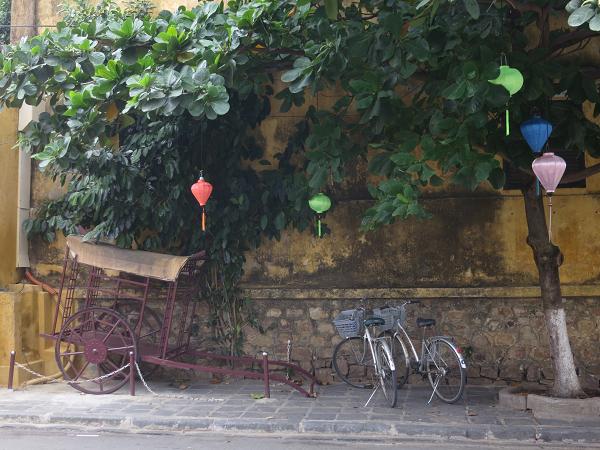
Hoian is a very touristy little old town, much too touristy for me really, but it has some nice features. Bicycles are at least as common as scooters here and much more common that cars so riding around is fun and easy. The old buildings are really lovely, but the whole town has been taken over by restaurants and cafes (some excellent) and tailoring shops. I gravitated to taking pictures of those parts of town that didn't have those features, but really, a street of wall to wall tailors would be more representative, though they are in pretty old buildings. 


Of course, the opportunity to get things made to measure is amazing since it's completely unaffordable for most westerners at home.  I got a winter coat done - not only would I normally never find a coat that fitted me this well, but I'd struggle to get the design I wanted.  I like super plain designs, whereas most designers for the mass market feel they have to compete by making their clothes elaborate in some way. 

I went to Kimmy Tailors which seemed to have one of the best reviews on Tripadvisor, sat down in front to a laptop and looked through over one hundred coat designs without the embarrassment of trying on things that make me look hideous.  I picked a Burberry pattern and asked to have the collar modified to make it even simpler.  The lady said we would fix that at the first fitting, which we did, with minor discussion and help from the older lady in charge of the fitting shop.  After picking the design, I chose my cloth, my lining and got measured.  I had to go back for two fittings and finally to pick up the coat, but I'm sure it still took me less time that picking one out off the rack.  Plus it cost $120 USD which isn't really a price for which we can get winter wool coats.

I had to turn the AC way up and try to photograph myself wearing this coat, but it didn't really work
I have only two minor criticisms of tailoring in Hoian.  First, the quality is honestly no better than you would get in average priced off the shelf clothing in Europe or America. If we were getting something tailored at home and paying ten times these prices we would expect it to be put together like a work of art. You really have to watch the quality at the fitting, for example, I asked them to straighten up the hem of the coat, which they said was fine.  It was a lot more fine two hours later after they had straightened it.  Secondly, they do rely rather on tourists being rushed.  I have heard this criticism from several other travelers who were only staying a couple of days, just time to get clothes made and no time to deal with quality issues after they got the clothes delivered. I was staying a week because I'm travelling very slowly and spending a lot of time writing, so I had plenty of time. Basically, you have to keep your expectations reasonable.

Boats on the river, on a day I cycled inland from Hoian
Oh, I nearly forgot! I also had a wallet that suited me perfectly but was falling apart. I took it into a shoe shop and they remade it for me in leather to exactly the same pattern. I was very happy about that, because I'd looked around the shops in Bangkok's shopping metropolis and found nothing that suited me.

Sunday, 12 August 2012

Day 499: Night bus to Hoian


I took my first ever sleeping bus from Nha Trang to Hoian and am now about halfway up the country of Vietnam. What can I say about the sleeping bus?  It wasn't exactly like in Harry Potter but I was comfortable enough.  I'm not so sure about the people who got on last, by which time there were more people than beds (well reclining seats, really), which seeemed to precipitate a major row between the driver and the assistant.  In Vietnam, if you book a bus through your hotel, you usually get picked up at your hotel and herded to your bus in a minivan, which is a very good idea for making sure tourists don't get lost on the way.  It takes a while though, I'm sure it was about 2 hours between when I was picked up and when we actually left Nha Trang.  But the most important thing is, in this case it made the difference between getting a bed and getting on a the bus station by which time they were all taken!